
Theme and Layout
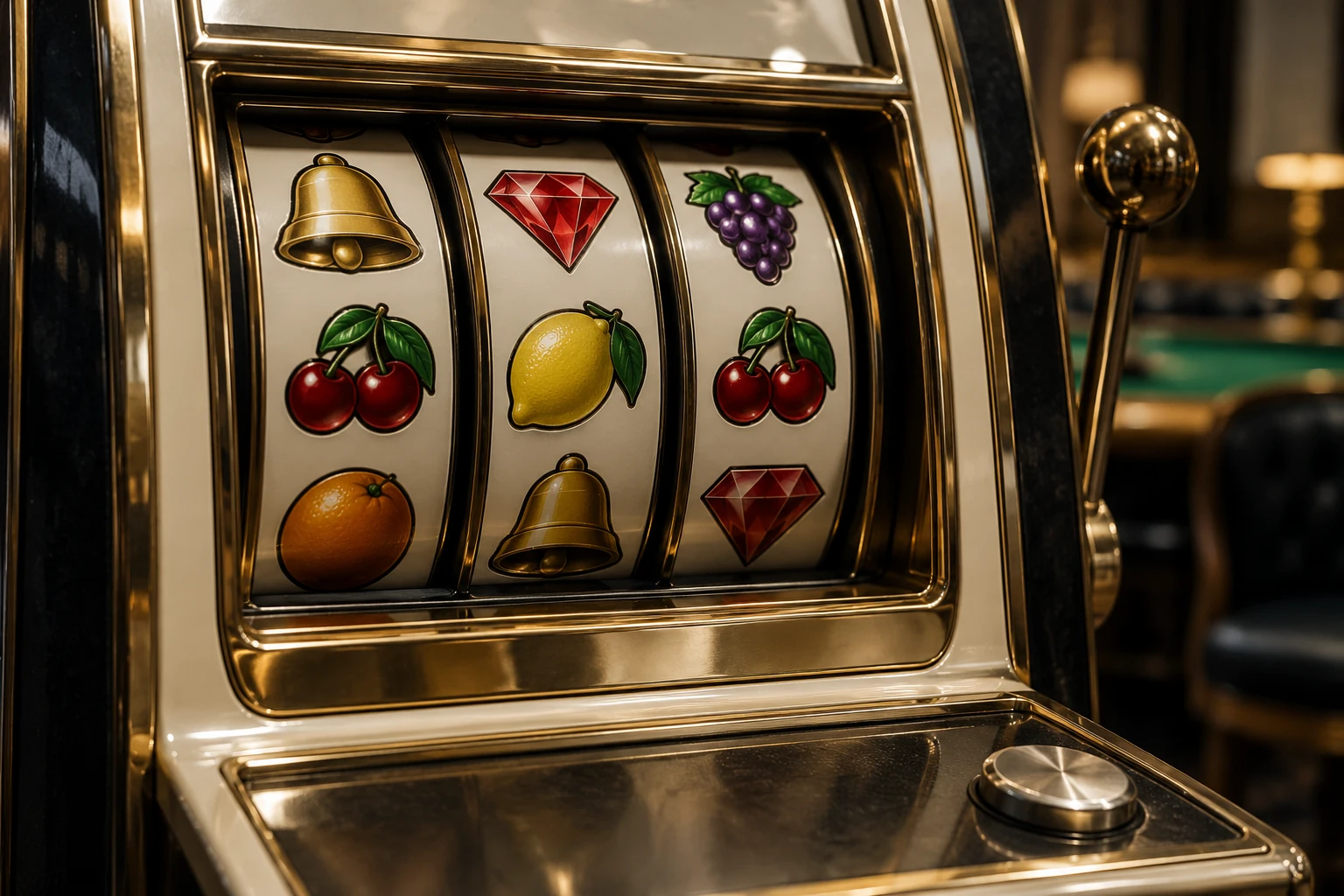
A slot screen carries two kinds of information. The theme sets the mood; the layout decides what the frame can hold. Reels and rows describe the visible arrangement: a five-reel, three-row screen shows fifteen symbol positions at rest. That count tells you how much room a symbol can occupy and how much space a feature overlay will need. When a title adds rows during a bonus, the frame itself changes shape, and positions outside the base grid may become active.
Artwork is a visual label, not a rule. Gold may mark a high-value symbol on one screen and a decorative frame on another. A pulsing symbol may belong to a feature state, or it may be idle animation. The legend and the rules panel carry the meaning. Read those two places before attaching significance to how something looks, and treat the theme as atmosphere rather than evidence.

Winning Geometry
Winning geometry is the rule that decides which symbol positions count as a group. The common forms are paylines, ways, clusters and anywhere-pays, and each produces a different reading habit.
A payline is a drawn path across the reels, usually running left to right. Three or more matching symbols on that path can form an award under the game rule. A screen with twenty fixed lines asks you to check twenty paths. Adjustable lines let you choose how many remain active, and the stake usually changes with that choice.
Ways counting works differently. Instead of fixed paths, matching symbols on adjacent reels can combine, so the number of possible combinations grows quickly. Clusters ask for a minimum group of matching symbols touching horizontally or vertically. Anywhere-pays ignores position and counts matching symbols across the whole grid.
Pragmatic Play’s Gates of Olympus Super Scatter is an external reference for the anywhere-pays habit. The official rules describe matching 8 to 30 symbols anywhere on the grid, so position does not matter for the award, only the count. Multiplier and Super Scatter mechanics belong to that title specifically. The reference carries no implication that the title is available on Cashlounge.
Symbol Roles
Symbols fall into loose roles. Regular symbols pay according to the paytable, with high-value symbols paying more for the same count than low-value ones. Wilds substitute for regular symbols under the game-specific rule. Scatters usually trigger a feature and often pay anywhere on the screen. Bonus symbols may open a separate round.
The word usually matters. Wild substitution depends on the rule of the named game, and some wilds carry multipliers or expand across a reel. A scatter may need a stated minimum count, and that count can differ between the base game and a free-spin round. Read the legend for the title in front of you rather than assuming a shared convention.
BGaming’s Hot Chilli Bells is a clear external example of a screen that states its own structure. The official product page identifies adjustable paylines and a Hold & Win bonus. Those two facts change how you read the screen: the line count is a setting you control, and the bonus has a named mechanic with its own rules. The page need not supply an RTP figure for the reading habit to work.
Feature State
A feature state is the condition the screen enters when a bonus begins. The base game and the feature can look similar but behave differently. Free spins, respins, Hold & Win rounds and cascading sequences each change what counts as a win and when the round ends.
SpinLogic’s catalogue lists Crimson Castle with Hold & Spin and Triggering Moon features. Those names describe mechanics on that title, as an external reference only. Hold & Spin on one screen may lock symbols for a set number of respins; on another it may reset a counter with each new symbol. The rules panel settles it.
Keep gameplay free spins separate from any promotional allocation. A free-spin feature inside a game follows the game’s rules. A promotional free-spin offer follows the terms attached to that offer, which may include eligibility, expiry and wagering conditions. The two can share a name and nothing else.
Credit and Paytable Units
Paytables quote awards in a unit. That unit may be credits, coins or the currency balance. The distinction matters because a paytable figure is not automatically a rupee amount. Many screens show a credit value that converts to currency through the stake setting.
Check where the decimal point sits. Some paytables show awards per line rather than per total stake, and the line bet is a fraction of the total. A figure that looks large may be a per-line value multiplied across active lines, or it may already be the total. The rules panel usually states the basis in one sentence.
Worked Single-Spin Example
Here is a clearly fictional example, with no claim about actual Cashlounge settings. Suppose a screen sets one credit at ₹1 and the total stake for one spin is 20 credits, or ₹20. A paytable entry of 50 credits for five matching high symbols would return 50 credits, or ₹50, on that stake.
For that single spin, the gross return is ₹50 and the single-spin net is +₹30, because ₹50 returned minus ₹20 staked equals ₹30. Earlier spins belong to a separate session total, which would add each spin’s net together. Keep the two figures apart: the spin net describes one round, and the session total describes the run.
Long-Run Numbers
Two numbers often appear in slot documentation: RTP and volatility. RTP is a theoretical long-run aggregate. It describes the share of total stakes a game is designed to return across a very large number of spins. It is not a forecast for your session, and a short run can sit far from the figure in either direction.
Volatility describes the spread of the outcome distribution. A high-volatility title has a wider spread of results; a low-volatility title has a narrower one. Hit frequency is a separate statistic, measuring how often any award occurs. Volatility does not promise a particular hit frequency, and the two figures should be read side by side rather than treated as one.
Previous random outcomes do not make a win due. A screen that has shown ten blank results is not owed a win, and a screen that has paid twice is not cooling down. Where a feature state persists across spins, that persistence follows the named rules of the title, not a memory of past results.
Two-Screen Comparison
Take two fictional screens side by side. Screen A uses a five-reel, three-row layout with twenty fixed paylines, a substituting wild and a scatter that triggers ten free spins. Screen B uses a six-reel grid with cluster wins, no paylines, and a Hold & Win bonus that locks matching symbols for three respins.
On Screen A, your reading habit is path-based. You check each active line for three or more matching symbols from the left. The wild can complete a line under the stated rule. The scatter needs its minimum count anywhere on the screen. A paytable entry of 40 credits on a ₹1 credit unit returns ₹40 gross on that line, before you account for the spin cost.
On Screen B, your reading habit is group-based. You look for touching clusters of a minimum size, and position matters differently. There are no lines to trace. The bonus state changes the frame: locked symbols stay in place while the respin counter runs down. A paytable entry here may quote a cluster award rather than a line award, so the unit check comes first.
The three named titles above are external references only, and their presence says nothing about availability on Cashlounge. For wider context on the site’s categories, see the Cashlounge casino overview, and for sport reading habits, the piece on reading cricket beyond the score. Cashlounge’s source line is 18+, with T&C applying; play carries a risk of loss.