
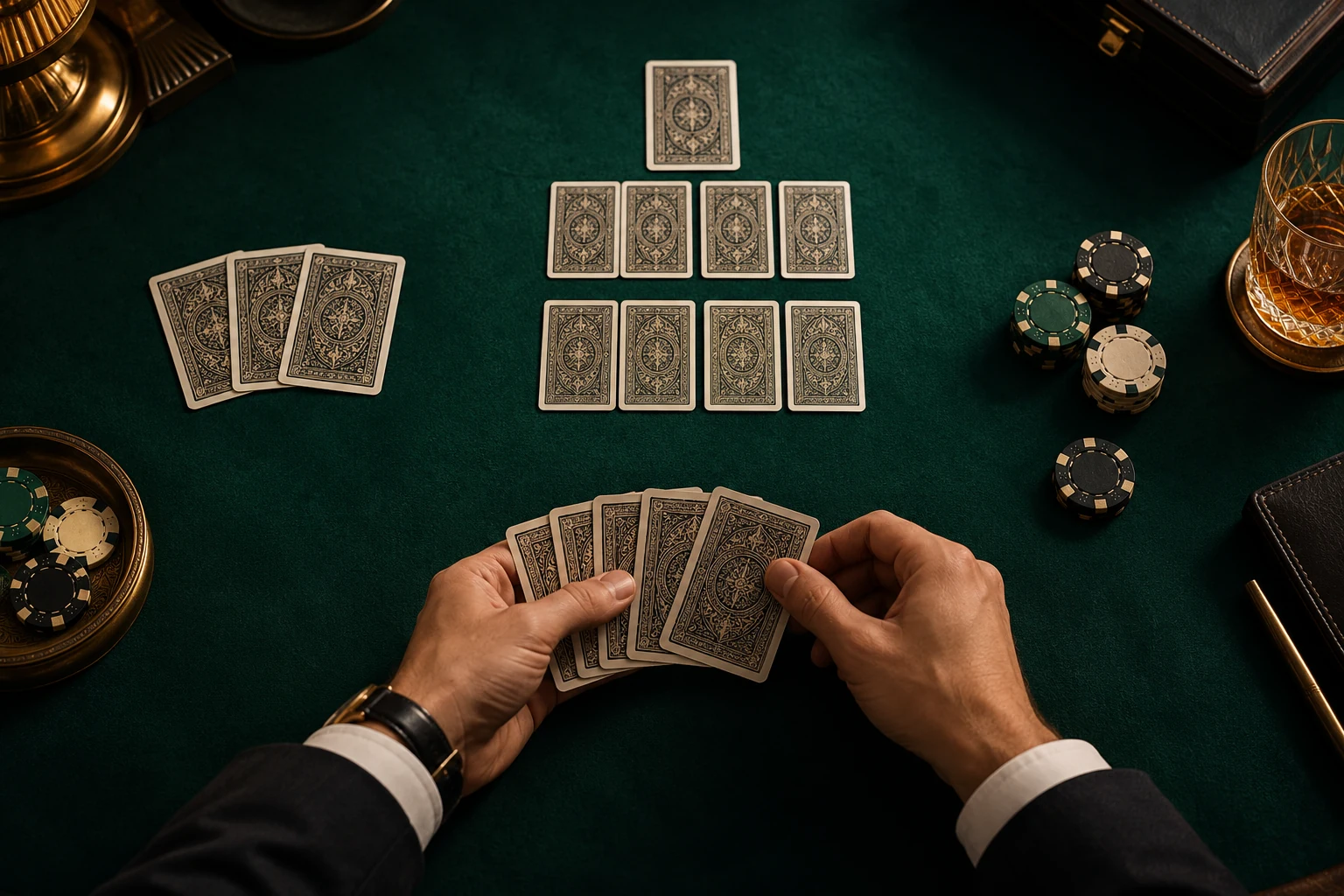
Picture a low table with three seats around it. At one, a player holds three cards close and waits on a dealer’s hand. At another, a single card sits face up in the middle while the dealer works through a stack. At the third, thirteen cards lie in loose rows as someone slides one into place. Cashlounge lists Teen Patti, Andar Bahar and Rummy among the card games it brings to desi players, and the three reward quite different habits of attention. The descriptions below draw on named external rules examples; they are not a statement of how every table on this site is configured.
Three Tables, One Evening
All three games use playing cards. Beyond that, the similarities thin out. Teen Patti is a comparison game with a betting decision attached. Andar Bahar is a race between two sides of the table. Rummy is a construction task in which you build valid groups from a changing hand. Knowing which of these you are sitting down to changes what you watch, what you remember and when you act.

Teen Patti: The Compare and Commit Table
One widely published version, the Evolution live Teen Patti product, frames the game as a comparison between a player’s three-card poker hand and the dealer’s. The player’s cards are visible to the player; the dealer’s are not, until the comparison is settled. That is one named external example. Hand rankings, the size of the ante, and how ties are settled can differ between Teen Patti variants, so treat any single description as a starting point rather than a universal rule set.
To see what a comparison means without inventing a ranking table, take a clearly fictional face-up hand. Suppose the player holds the eight of hearts, the eight of spades and the king of clubs. The dealer’s three cards stay face down through the betting stage. The player’s own three cards are the only private information they hold, and the dealer’s hand is the unknown quantity the round is built around. A pair plus a high card is one shape; three unrelated low cards is another. The named version settles the comparison after the betting stage, not before it.
Round Rhythm
In the Evolution version, the round opens with an ante. Cards are dealt, the player sees their own three, and then chooses whether to play or fold. In that named version, a Play stake equals the Ante, while a Fold forfeits the Ante already placed. The dealer’s hand is then revealed and the two are compared. Because the dealer’s cards remain hidden through the decision, the player commits before the full picture is available. That single choice, made once per round, is the heart of the format.
The order matters. Ante first, then the play-or-fold decision, then the comparison. The cost of each path is fixed by the table’s stated terms rather than guessed at. This is a narrower decision than a multi-street poker game, and it is best understood on its own terms rather than as a shortened version of something else.
Side Bets and Variants
The same named version offers separate side bets, evaluated on their own terms rather than folded into the main player-versus-dealer comparison. A side bet is a distinct wager with its own conditions, so its result can differ from the main hand’s result. Other Teen Patti variants exist with different structures, and none of those should be assumed present at a given table. The practical point is that Teen Patti asks you to compare, commit and then accept a decision made on limited information.
Andar Bahar: The Waiting Rank
Andar Bahar is built around a single reference card. That card is dealt face up first, and its rank becomes the target. Cards are then dealt alternately to two sides, Andar and Bahar, and the round ends when a card matching the reference rank appears on one of them. Players typically back one side before the dealing begins. There is no hand to arrange and no card to discard; the whole game is a countdown toward a match.
The Evolution Super Andar Bahar product page describes a version where the first dealing side is Andar, with separate side bets on how many cards will be dealt. That detail matters because it shows how a simple premise can carry extra layers. In the basic form, though, the decision is narrow: pick a side, then watch the cards fall.
Round Rhythm
An Andar Bahar round has a steady, almost mechanical pulse. Reference card, then Andar, then Bahar, then Andar again, until a rank matches. Take a fictional sequence to see the shape. Suppose the reference card is the seven of clubs. The dealer places the first card on Andar: the three of diamonds. The next goes to Bahar: the jack of hearts. The next to Andar: the seven of spades. The round stops there, because the seven of spades matches the reference rank. The suit did not matter; the rank did.
Because the reference card is visible to everyone, the information is shared rather than hidden. What changes from round to round is the target rank and where in the alternation the first match lands. Nobody is bluffing about a private hand. The suspense is collective, and the outcome arrives on its own schedule.
Variants and Card Counts
Some Andar Bahar formats add side bets on the number of cards dealt before a match, or on which side will win and in how many cards. Others adjust the dealing order or the number of decks. These additions turn a single side choice into a small set of related wagers. As with Teen Patti, the presence of such options at any particular table is a matter for that table’s own rules.
Rummy: The Hand You Arrange
Rummy is the odd one out because the cards in your hand are not simply compared; they are organised. In the 13-card Indian Rummy example published by RummyCircle, a player arranges thirteen cards into sequences and sets, and must hold at least two sequences, one of which is pure. A sequence uses consecutive cards of the same suit. A set groups cards of the same rank across different suits. A pure sequence contains no substitute joker.
That structure turns Rummy into a game of gradual improvement. You draw a card, decide whether it helps, and discard one that does not. Over several turns a messy hand becomes a planned one. The skill lies in seeing which cards can serve two purposes and which are dead weight.
Sequences, Sets and the Pure Sequence
The pure sequence requirement is the detail that trips up newcomers. A hand can look well organised and still fail because every sequence relies on a joker. Keeping at least one run of consecutive same-suit cards untouched gives the rest of the hand room to use substitutes. Beyond that, the exact declaration rules, the number of jokers and the treatment of dropped hands vary between Rummy formats, so the RummyCircle example is best read as one clear illustration rather than a universal code.
Round Rhythm
Rummy rounds move through a draw and a discard. There is a draw pile and a discard pile, and each turn is a small cycle of pick up, assess, discard. The visible information includes the discard pile and the cards other players pick and throw, which together give clues about what they are collecting. A player who discards a card you need is a small gift; a player who keeps drawing from the closed pile may be building something you cannot see.
What Each Table Asks You to Follow
Teen Patti asks you to follow a comparison: your three visible cards against a hidden dealer hand, with one ante and one play-or-fold choice before the reveal. Andar Bahar asks you to follow a rank: one visible card and the alternating deal that chases it, with the side you back decided before the first card lands. Rummy asks you to follow patterns: your own unfinished sequences, the discards that hint at others’ plans, and the discipline of keeping one clean run. Put side by side, the three games cover hidden information, shared suspense and patient construction. Cashlounge lists all three for desi players, alongside slots, live dealer tables and cricket. The site is for adults 18 and over, play carries financial risk, and T&C apply.